How to Cut Cardstock Cleanly: Card Sizes and Straight Edges
Straight, square cuts with scissors, a craft knife or a paper trimmer, plus the measurements for A2 card bases, mats and other common card sizes.
Tutorial at a glance
Materials
- Cardstock
- Ruler and pencil
- Scissors
- Craft knife, metal ruler and cutting mat (optional, adult use)
- Paper trimmer (optional)
- Eraser
A card looks handmade in a good way when its edges are straight and its corners are square. Learning how to cut cardstock accurately is what makes that happen, and it depends far more on measuring and holding the paper still than on owning a particular tool. Scissors, a craft knife or a paper trimmer can all give a clean edge.
This guide compares the three tools, shows how to mark a cut, then works through the two cuts used on almost every card: halving a letter sheet into two A2 card bases and cutting a mat that leaves an even border.
Choosing a cutting tool
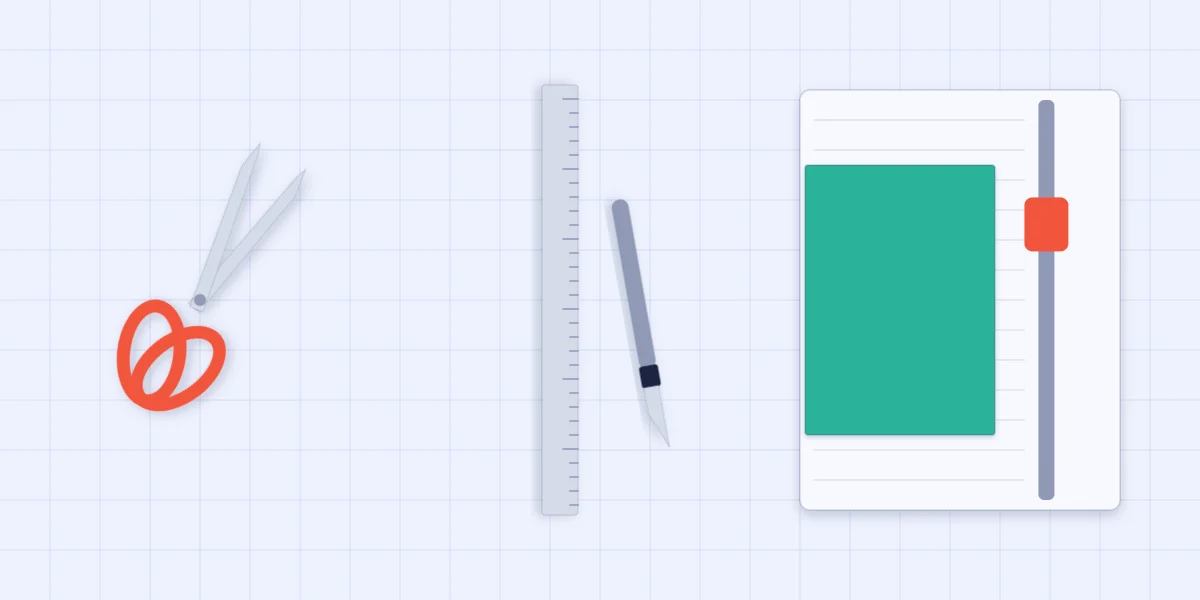
Each tool has a job it does best.
| Tool | Best for | Limits |
|---|---|---|
| Scissors | Curves, hearts, leaves and short straight cuts | Long straight lines tend to wander |
| Craft knife, metal ruler and cutting mat | Long straight cuts, narrow strips, windows cut from the middle of a panel | An adult tool; needs a sharp blade and a firm hand on the ruler |
| Paper trimmer | Fast, repeatable straight cuts and square corners | Cannot cut curves; the blade or cutting strip wears and needs replacing |
Measure twice, mark lightly
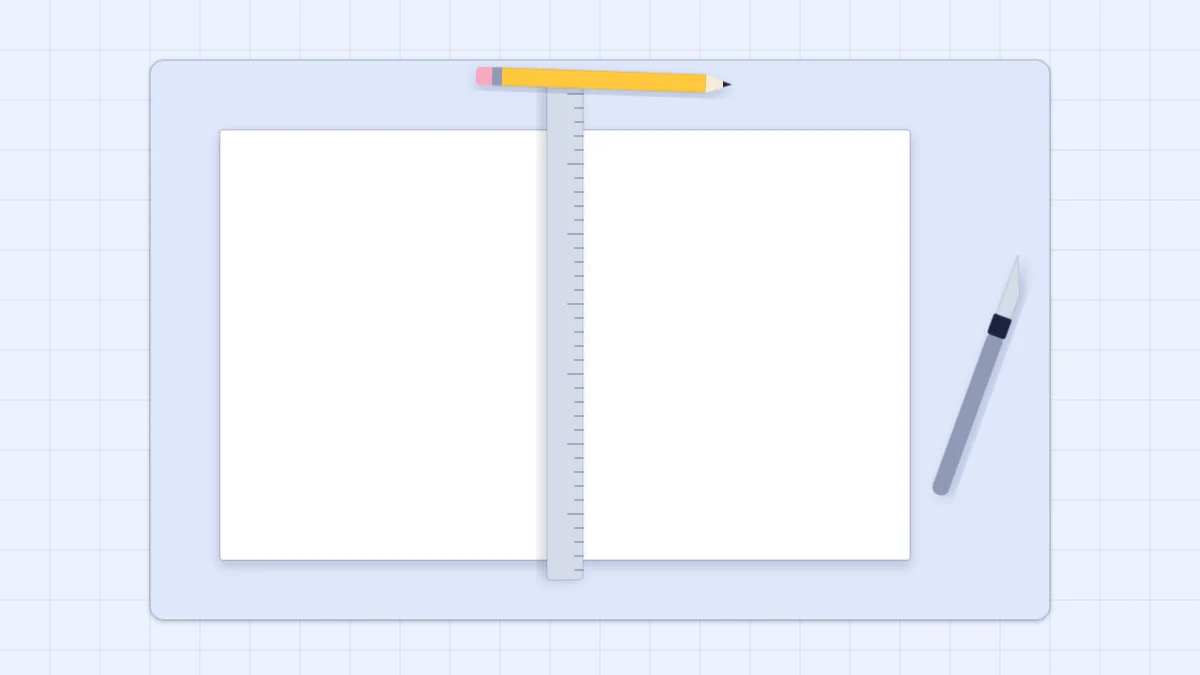
Most crooked cuts are measuring mistakes, not cutting mistakes. A single pencil mark tells you where the cut starts but not where it ends, so the line can drift by the time it reaches the far edge.
- Measure from the same edge of the sheet each time and make a small tick near the top edge and another near the bottom edge.
- Check both ticks again before cutting. If they disagree with the ruler, one of them is wrong.
- Join the ticks with a light pencil line, or simply line the ruler up on both.
- Mark on the back of the cardstock where you can, so no pencil shows on the front.
Press lightly. A hard pencil line dents the surface and will not erase cleanly.
Cutting with scissors
Open the scissors wide and cut with the middle of the blades in long strokes, stopping each stroke before the tips close. Closing the tips leaves a small nick in the edge. Keep the scissors pointing straight ahead and feed the paper into them with your other hand, turning the paper, not the scissors, on curves.
Cut just to the waste side of the pencil line so the line is removed with the offcut. Supervise children with scissors, and give them lighter cardstock that takes less force to cut.
Cutting with a craft knife and metal ruler
Always work on a cutting mat. It protects the table and gives the blade a surface to bite into, which keeps the cut line clean.
- Lay the metal ruler along the marks so that it covers the piece you want to keep. If the knife slips, it then runs into the waste.
- Press the ruler down with spread fingers, keeping fingertips back from the edge.
- Draw the knife toward you along the ruler with light pressure. Make two or three light passes instead of one heavy one.
- Lift the ruler only after the piece has come free.
A plastic ruler is not a safe guide, because the blade can shave into it or ride up over the edge. Change the blade as soon as it starts to drag or tear the paper. A dull blade needs more force, and more force is what makes a knife slip.
Watch out
A craft knife is an adult tool. Cut on a cutting mat, away from the hand that holds the ruler, and cap or retract the blade whenever you put it down. Children should have an adult make knife cuts for them.
Cutting with a paper trimmer
Slide the sheet under the cutting rail, push its top edge flat against the trimmer’s guide ledge and read the measurement on the ruler arm. Hold the paper down beside the rail and move the blade in one steady pass. The ledge is what keeps the cut square, so a sheet that is not sitting flat against it produces a slanted edge.
Cutting a letter sheet into two A2 card bases
The standard A2 card is 4.25 x 5.5 in (10.8 x 14 cm) folded. One US letter sheet (8.5 x 11 in) makes two bases.
- Lay the sheet with its long, 11 in edge running left to right.
- Mark 5.5 in (14 cm) from the left edge at the top and at the bottom.
- Cut along the marks. You now have two pieces of 8.5 x 5.5 in (21.6 x 14 cm).
Each piece is scored and folded at 4.25 in to make a side-fold card. For a top-fold (tent) card, cut the sheet lengthwise instead into two pieces of 4.25 x 11 in and score each at 5.5 in. With A4 paper, halving a sheet in the same way gives a very similar, slightly narrower and taller card.
Common card sizes and mat sizes
A mat is cut 1/4 in (6 mm) smaller than the piece beneath it in both directions. Centered, that leaves a border of 1/8 in (3 mm) on every side. For an A2 card the front is 4.25 x 5.5 in, the mat is 4 x 5.25 in and a panel on top of the mat is 3.75 x 5 in. The table gives the same numbers for other common sizes.
| Card | Folded size | Cut the base to | First mat |
|---|---|---|---|
| A2 | 4.25 x 5.5 in (10.8 x 14 cm) | 8.5 x 5.5 in | 4 x 5.25 in |
| A6 | 4.5 x 6.25 in (11.4 x 15.9 cm) | 9 x 6.25 in | 4.25 x 6 in |
| A7 | 5 x 7 in (12.7 x 17.8 cm) | 10 x 7 in | 4.75 x 6.75 in |
| Square | 5.5 x 5.5 in (14 x 14 cm) | 11 x 5.5 in | 5.25 x 5.25 in |
These US card names come from envelope sizes and are not the same as international A-series paper sizes. Square and unusually sized cards can cost more to send, so check with the postal service before making a batch for mailing. If you plan to make your own, an envelope can be folded to fit any card.

What to do next
Which sheet to cut in the first place is covered in the guide to cardstock weights and finishes, and stacking several mats is explained in layering cardstock. With two accurate base pieces on the table, the next step is the crease: how to score and fold a card.
Frequently asked questions
How do I cut cardstock straight without a paper trimmer?
Mark the measurement at both ends of the cut and join the marks with a light pencil line. Cut along it with long-bladed scissors in long strokes, or have an adult cut along a metal ruler with a craft knife on a cutting mat. Marking both ends is what keeps the line from drifting.
What size do I cut cardstock for an A2 card?
Cut the base to 8.5 x 5.5 in and fold it at 4.25 in for a side-fold card of 4.25 x 5.5 in (10.8 x 14 cm). One US letter sheet cut in half gives two of these bases. A first mat for the front is 4 x 5.25 in.
Why are the edges of my cardstock rough or torn?
Rough edges usually come from a dull blade or from pressing too hard in a single pass. Fit a fresh blade and make two or three light passes with a craft knife. With scissors, use the middle of the blades and avoid snapping the tips shut.